
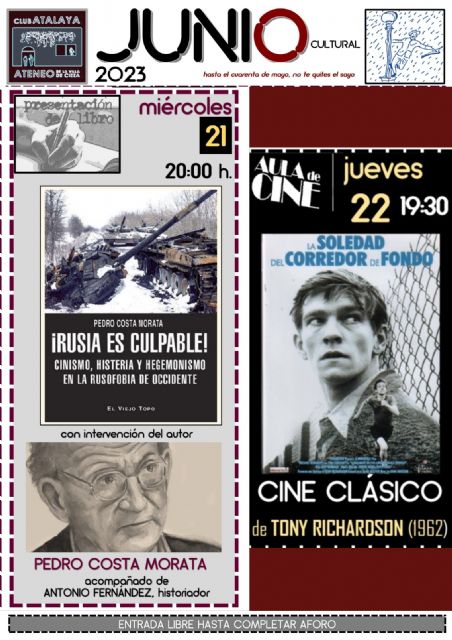
After an intense semester of film and literature, the final book presentation of the June Cultural Days organized by the Atalaya Club will take place on Wednesday the 21st at 8:00 p.m. Pedro Costa Morata, author of "Russia is Guilty! Cynicism, Hysteria, and Hegemonism in the Russophobia of the West," will present his latest book, accompanied by historian Antonio Fernández.
In "Russia is Guilty! Cynicism, Hysteria, and Hegemony in the Russophobia of the West," the author aims, above all, to express his discomfort and disagreement with the current monolithic reporting on the Russian-Ukrainian conflict, a reflection of an intentionally distorted interpretation of history and international politics. He maintains the thesis that this crisis is essentially the result of the political indecency and historical perfidy of the West, led by the United States, which uses the EU as an acolyte and NATO as an aggressive neo-imperialist instrument. To this end, he revives the cry of "Russia is Guilty!" with which the Spanish coup regime launched its Blue Division in 1941 against the USSR, invaded by the German army, contributing to the cruel siege of Leningrad. And he is shocked that this is the same slogan with which the most distinguished West anathematizes today's Russia, assimilating it to the Soviet Union that disappeared in 1991 as a justification for eroding it and preventing its recovery as a great power, while rejecting its willingness to cooperate.
These pages, which begin with an open condemnation of Spain's role in this crisis and the irresponsible role of its government, describe the evolution of Russia following the catastrophe of the disintegration of the USSR, the expansion of NATO, encircling Russia against the promises repeatedly made to the contrary in 1990-1991, the providentialism that the United States attributes to itself in order to subjugate the world, and the conflictive and worrying history of independent post-Soviet Ukraine.
The following day, Thursday the 22nd at 7:30 p.m., a classic film will be screened, one of the most timeless films of all time: "The Loneliness of the Long Distance Runner" (1962), directed by Tony Richardson. It tells the story of Colin Smith, a young working-class man from the suburbs of Nottingham who falls into a life of crime. After being tried, he is imprisoned in a reformatory where his skills as a long-distance runner earn him privileges within the prison.
A magnificent work that delves into the depths of working-class youth in England at the time, and focuses on the dichotomy between running or stopping; between fleeing or fighting back; between looking back or looking forward. It's a cinematic paean to freedom, not only physical but also of thought, an invitation to reflect on when to run and when not to, and above all, on the reasons for doing it or not doing it.


 English
  Spanish