
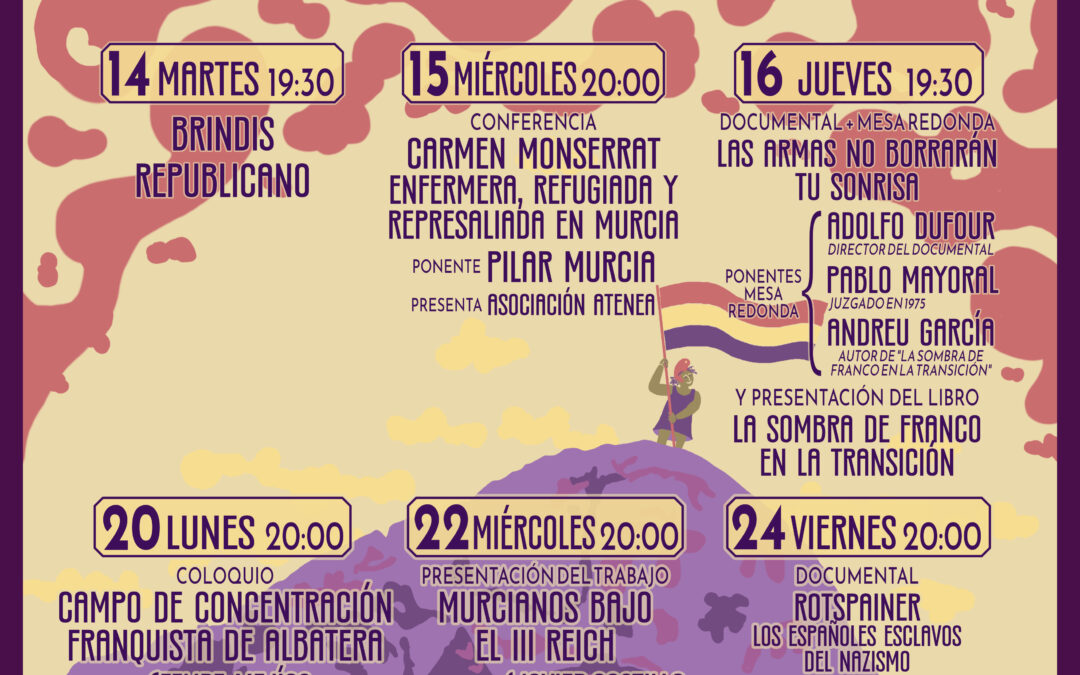
Every spring, the Atalaya Ateneo Club of the town of Cieza springs back into existence.
Republican trichomycosis. For another year, and it's already twenty-two, the socio-cultural association has
organized a series of republican events, whose scheduled activities will take place from the 14th
until April 24th at the collective's facilities.
The Atalaya Club, founded in 1967, was re-established as the Ateneo de la Villa Association of
Cieza, April 14, 1986, anniversary of the Second Spanish Republic. Its essential purpose is
“the civic, cultural and humanistic development of the residents of Cieza”, being
One of its objectives is “the recovery and dissemination of popular historical memory in
all its facets, and in particular those of the working classes and other silenced pages or
distorted by official history.”
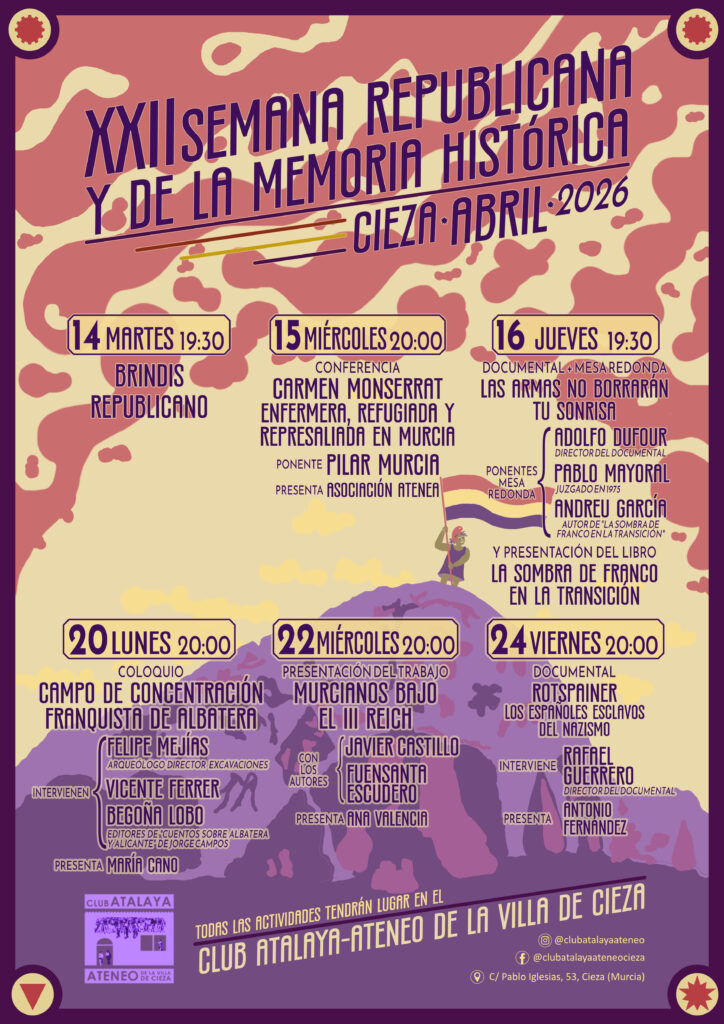
As every year, the program begins on the 14th at 7:30 p.m., with the toast
Republican. On Wednesday the 15th at 8:00 p.m., the presentation "Carmen Monserrat,
"Refugee and persecuted nurse in Murcia" by Pilar Murcia, researcher-
collaborator of the Federation of Historical Memory Associations of the Region of Murcia.
The story of Carmen Monserrat, who gave the best of her professional training and
human, she is part of that very large group of women, professionals and fighters of
our rearguard that have gone down in history as the unremembered ones.
The screening of “Weapons are not” is scheduled for Thursday the 16th at 7:30 pm.
"They will erase your smile," a documentary about Arturo Ruiz and the forgotten dead of the
Transition. Arturo Ruiz was the first crime that went down in history as the “week
"Black Street" in Madrid, one of the most tragic moments of the Transition, because the next day
Another student, Mari Luz Nájera, was murdered while protesting precisely against the
Ruiz's death. And that same night, five labor lawyers linked to the PCE and CC.
OO. were massacred in their office at 55 Atocha Street in Madrid.
Adolfo Dufuor, director of the documentary, and Pablo Mayoral will speak at this event.
sentenced to death in 1975 in the last courts-martial of the dictatorship and
survivor of the last Francoist executions and Andreu García, author of the book “The
"Franco's shadow in the Transition," a key work to dismantle, through data
incontrovertible and analytically rigorous, the conceptual structure of the myth of the “model” Transition
and peaceful.”
This first week of the program for the republican events concludes the
Sunday the 19th with a meeting with Begoña Lobo and Vicente Ferrer, from the prestigious
Media Vaca publishing house. Republic, books and rice to talk about some of their books (Stories
Regarding Alicante and Albatera, The war is over, Goodbye to the future,…) of the process
editorial and the concern that led them to its publication. These copies and others
Titles from the publisher will be available for purchase at this event. For this meeting, the following is required:
Pre-registration via email atalaya.ateneo@gmail.com.
Next Monday, April 20th, at 8:00 PM, a session will take place on the
Francoist concentration camp of Albatera, in which Felipe Mejías López,
The archaeologist in charge of the excavations will speak about the findings produced in the
themselves and what they reveal about life in the concentration camp and the repression in the
The same. In the subsequent discussion, the editors of the work Tales about Albatera will participate and
Alicante by Jorge Campos.
The presentation of the works “Murcians under the Third Reich” and “Deported Murcians”
in the Nazi concentration camps,” by the authors Javier Castillo, director of the Archive
General of the Region of Murcia and Fuensanta Escudero, professor and doctor in History,
It will be on Wednesday the 22nd at 8:00 PM.
And to close the events of this edition, on Friday, April 24th at 8:00 pm, there will be
will be screened, with an introduction by the journalist and director of the documentary, Rafael Guerrero,
'Rotspanier. The Spanish slaves of Nazism', which explores the forced labor to which
Tens of thousands of Spanish Republican exiles were subjected to this, especially in
France, for the construction of military infrastructure in territories occupied by the
Germans during World War II and sustain their war-industrial economy.
Rotspanier was the name the Germans used for the Spanish Republicans.
Up to 70,000 of those 'Spanish Reds' were subjected from 1939 onwards to "terrible"
working conditions in France, Germany, the Channel Islands and North Africa.


 English
  Spanish