





This Thursday, March 1st, the Fray Pasqual Salmerón Center for Historical Studies' Lecture Series begins at 8:00 PM in the Padre Salmerón Library in Cieza with the lecture: "Cieza: The Image of the City" by Fulgencio Angosto Sánchez.
The cycle begins with an interesting conference on the urban planning of Cieza, a matter of no small importance, since in a small scale, we can compare the urban plan of the city with that of Barcelona, in that it is juxtaposedthey have two totally different typologies: the medieval-modern, the Historic Quarter, whose street layout (articulated to the north by Cadenas Street, in the center by Angostos-Santo Cristo-Tercia Streets and to the south on the axis of Larga-San Sebastián Street) adapts to the sense of the meander that winds through the origin of the city (and settled on the "slab", a prodigious conglomerate crust that makes possible the security of the urban settlement on the marly fluvial terrace on which the historic quarter sits); and the expansion, of a checkerboard, orthogonal or chessboard typology, designed by D. Diego Templado, a mining engineer, based on the prototype of Cerdá's for Barcelona (1859): with square blocks, wide, straight and well-connected streets to facilitate traffic and the transport of motor vehicles, in addition to the fact that with this plan the land was used to the maximum for the construction of housing and green spaces. The structuring elements of this space are: Gran Vía Juan Carlos I Avenue and its extension into Abarán Avenue, Juan XXIII Avenue, Azorín Avenue, Camino de Murcia, Camino de Madrid and the intersection of Avenida de Italia with Avenida Diego Jiménez Castellanos.
The downside to this plan is that there is no connection between the "old part" and the "new part," divided by Mesones Street, the old Camino Real, and the pedestrian rest area toward the plateau and Murcia-Cartagena.
Fountain: Victor Manuel Martinez Lucas.
Organized by: Fray Pascual Salmerón Center for Historical Studies, Cieza.

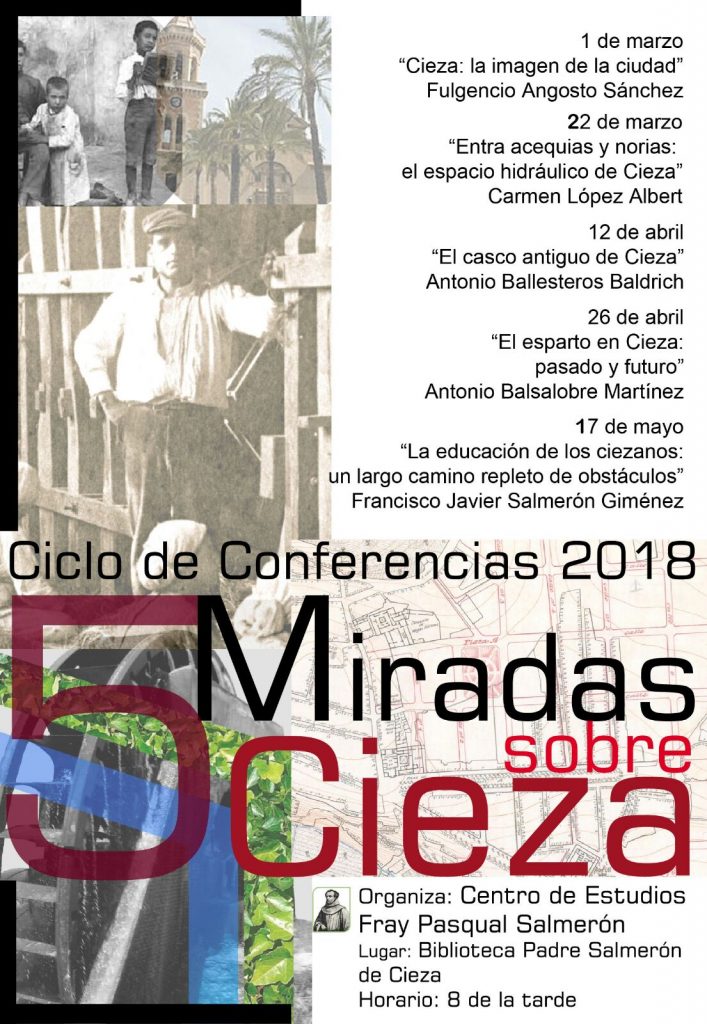
Poster for talks at the Fray Pascual Salmerón Historic Center in Cieza.