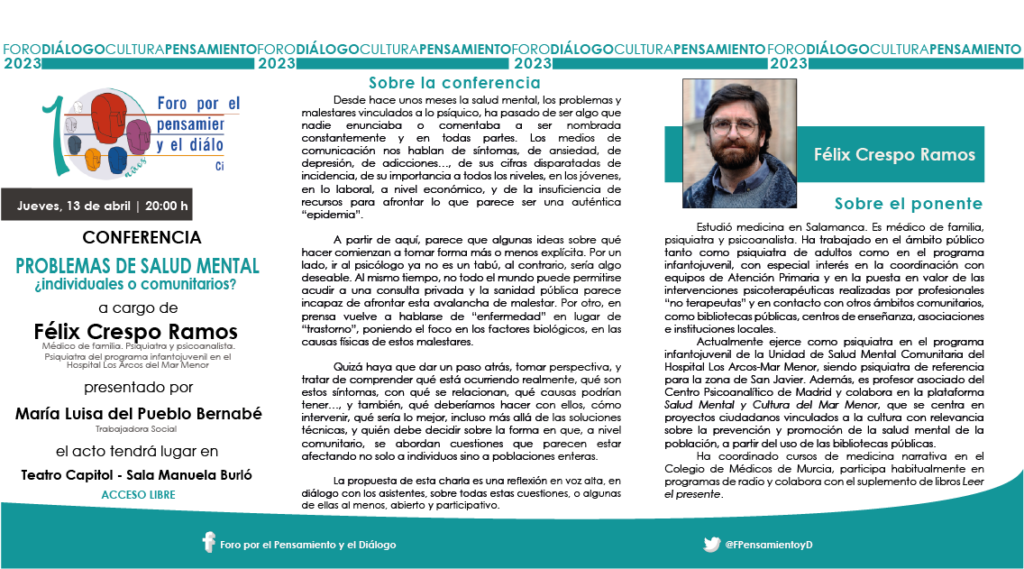
The Forum for Thought and Dialogue, a cultural association that has celebrated its first decade of existence by carrying out outreach activities aimed at cultivating critical thinking, is organizing the conference "Mental Health Problems: Individual or Community-Based?"
The lecture will be given by Félix Crespo Ramos, a family doctor, psychiatrist, and psychoanalyst, as well as a psychiatrist in the child and adolescent program at Los Arcos del Mar Menor Hospital.
The event will be presented by social worker María Luisa del Pueblo Bernabé, this Thursday, April 13, at 8:00 p.m. in the Capitol Theater – Manuela Burló Room, with free admission.
Felix Crespo Ramos:
He studied medicine in Salamanca. He is a family doctor, psychiatrist, and psychoanalyst. He has worked in the public sector both as an adult psychiatrist and in child and adolescent programs, with a special interest in coordinating with primary care teams and promoting psychotherapeutic interventions delivered by non-therapeutic professionals, in contact with other community settings, such as public libraries, educational centers, associations, and local institutions.
He currently works as a psychiatrist in the child and adolescent program of the Community Mental Health Unit at Los Arcos-Mar Menor Hospital, serving as the referral psychiatrist for the San Javier area. He is also an associate professor at the Madrid Psychoanalytic Center and collaborates on the platform. Mental Health and Culture of the Mar Menor, which focuses on citizen projects linked to culture with relevance to the prevention and promotion of mental health among the population, based on the use of public libraries.
He has coordinated narrative medicine courses at the College of Physicians of Murcia, regularly participates in radio programs, and collaborates with the book supplement Read the present.
About the conference
For a few months now, mental health, the problems and ailments associated with the psyche, has gone from being something that no one mentioned or commented on to being mentioned constantly and everywhere. The media tells us about symptoms, anxiety, depression, addictions, and so on, about their staggering incidence rates, about their importance at all levels: among young people, in the workplace, and economically, and about the lack of resources to confront what appears to be a true "epidemic."
From this point on, it seems that some ideas about what to do are beginning to take shape, more or less explicitly. On the one hand, going to a psychologist is no longer taboo; on the contrary, it would be desirable. At the same time, not everyone can afford to go to a private consultation, and public health care seems unable to cope with this avalanche of discomfort. On the other hand, the press is once again referring to "illness" instead of "disorder," focusing on biological factors, on the physical causes of these ailments.
Perhaps we need to take a step back, gain perspective, and try to understand what's really happening, what these symptoms are, what they're related to, what causes they might have... and also, what we should do about them, how to intervene, what would be best, even beyond technical solutions, and who should decide on how, at the community level, we address issues that seem to be affecting not only individuals but entire populations.
The purpose of this talk is to reflect aloud, in dialogue with the audience, on all of these issues, or at least some of them, in an open and participatory manner.