


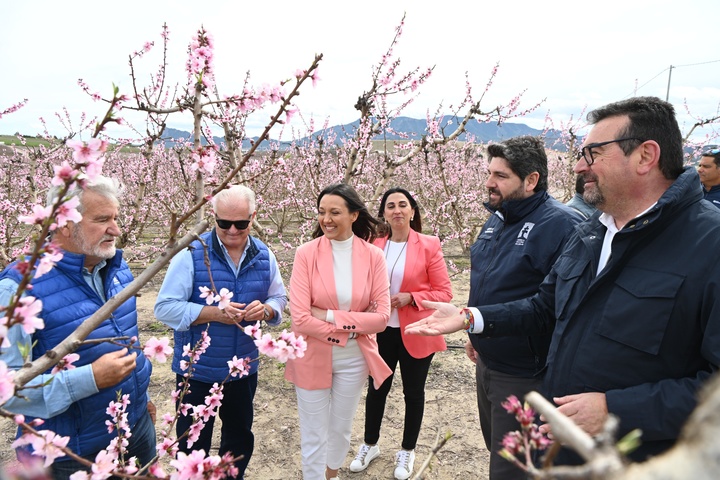


The President of the Government of the Region of Murcia, Fernando López Miras, visited the Cieza flowering season today, where he emphasized that this landscape of fruit trees in bloom "is a spectacle of the Region's nature" that "unites two of our greatest pillars: agriculture and tourism. The flowering season serves as a lever for growth, because it allows us to boost inland and nature tourism."
As an example of this growing tourism development, the president noted that the flowering season attracted some 60,000 visitors in 2024 to the municipality of Cieza alone, and emphasized that it helps boost economic activity outside the summer season.
Cieza, a benchmark in the production of stone fruit
“The fruit trees that are a spectacle of nature today will tomorrow be the economic and social engine of the Region, thanks to the export of their fruit,” stated López Miras. In 2024, the Region exported nearly 143,000 tons of stone fruit worth more than €256 million, the second highest figure in the country by province, after Lérida.
Stone fruit exports from the Region of Murcia represent 19 percent of those from all of Spain, and their main destinations are Germany, France, Italy, and the Netherlands. In total, the Region of Murcia has nearly 21,000 hectares devoted to these fruit trees, mainly apricots, peaches, nectarines, flat peaches, and plantains.
Cieza also exports a large quantity of apricots
Regarding apricots specifically, the Region of Murcia was the leading autonomous community in foreign sales in 2024, with 29,000 tons generating €55 million. Exports of this fruit represent 31.8 percent of the national total.
The Community, through the Murcia Region Tourism Institute, is financially collaborating with the programming of the flowering activities, as well as with the organization of the Degusta Cieza gastronomic fair.
