


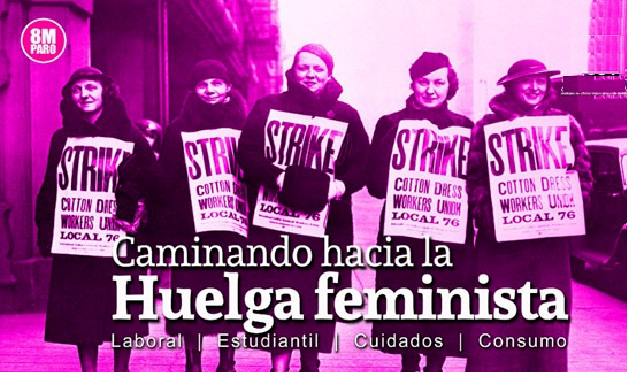


The Department for Women's Affairs announced in a press release that on International Women's Day, March 8th, for the first time in history, a legal strike is being organized to demand real equality of opportunity and rights between women and men.
The statement asserts that hundreds of state, regional, and local women's organizations support the call, which has been joined by various unions under the slogan "If we stop, the world stops."
The CGT has called a general strike, and its notice has been registered with the Ministry of Employment, which has not challenged it. It has therefore been legalized within the framework of the workers' right to strike.
For their part, the CCOO, UGT, and USO are calling for partial strikes, also legalized by the Ministry of Employment. They will operate as they normally do in the case of a strike, with committees and information panels in all the sectors where they have influence.
Regarding the timing of these partial strikes, there are variations across sectors, but in general, unions call for a two-hour halt in production, starting at 12:00 and 4:00 p.m. Morning and afternoon strikes are not mutually exclusive; both can be carried out.
All workers are invited. However, the feminist movement urges women in particular to participate because it aims to demonstrate that "without women's labor, paid or unpaid, nothing works. That is the core of the call: 'If we stop, the world stops.'"
The 8M Commission's arguments are as broad as the diverse problems women face simply because they are women. They denounce gender-based violence in all its forms and demand more funding to combat it, but they also highlight the greater precariousness of women in the labor market, the persistence of barriers to their professional advancement, and their discrimination in wages.
Along the same lines, they denounce the budget cuts affecting caregiving, the lack of recognition of domestic work, which women shoulder to a greater extent, the poverty that also affects them more, and the vulnerability of certain groups, such as foreign women, among other issues.