


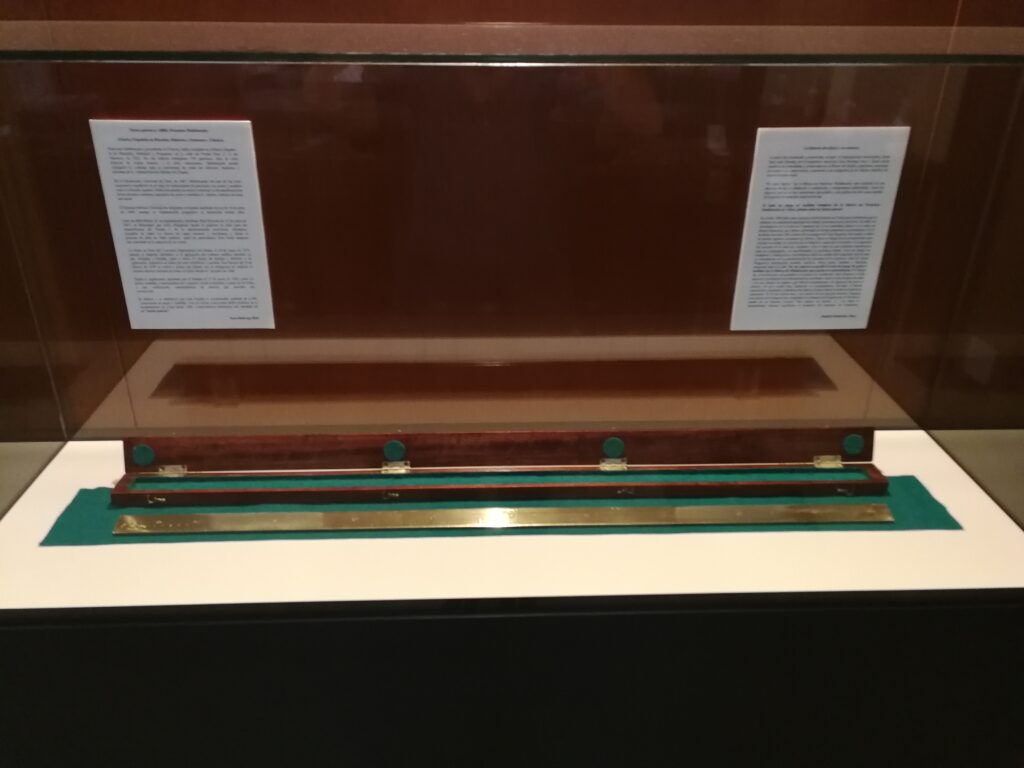


The history of the object and its context:
The piece was located and stored, always in municipal facilities, for several decades by the municipal architect Juan Buitrago Ruiz, and will now be housed and preserved in the Siyâsa Museum. For its display, a recently acquired showcase will be used for the first time, designated as the Siyâsa Museum's "showcase of the month" in the building's lobby.
The standard meter from Francisco Malabouche's factory is made of an alloy such that its expansion or contraction at ambient temperatures is very small so that it would not have appreciable variations and thus be useful as a measure of length in any season of the year.
If there was a complete set of measurements from Francisco Malabouche's factory in Cieza, where are the other pieces?
In 1904, revolutionary events in Cieza led to the loss of municipal ownership of the remaining items in the collection. In April, the tenants of the Cieza Consumption Tax were abusing their power in collecting these taxes, which had recently increased significantly. On the 26th of that month, some 500 settlers from the Cieza countryside arrived in the city, joined by several hundred workers. They all went to the town hall to present their demands to the mayor, requesting a reduction in the fees for those living in the outskirts of town or the abolition of the Consumption Tax lease. When their demands were not met, the demonstrators left shouting "Down with the Consumption Tax!" and destroyed and burned all the tax collection booths. They then gathered at the Consumption Tax office on what was then López Puigcerver Street, destroying furniture, archives, books, weights, measures, and scales, throwing everything into the street. In this way, the rest of the set of weights and measures from the Malabouche factory, which the town hall owned, was lost.On the same day, during a scuffle with guards at the town hall door, shots were fired, and the following day the clashes continued, resulting in several civilians being wounded by sabers and one by a Mauser bullet, who died shortly afterward. The funeral took place the next day. A large number of mourners attended the procession, with the open coffin carried on the shoulders of young female workers from the edge of town to the cemetery. On the 30th of the same month, in response to the events described, two infantry companies from the Seville Regiment, commanded by a Lieutenant Colonel, arrived from Cartagena.
To calm tempers, on May 7 the city council initiated proceedings against the successful bidder of the Consumption Tax.
The piece and its case have been restored by Ginés Cano Morote.
Francisco Malabouche and his "Spanish Factory of Scales, Balances and Roman Scales", in Valencia.
Originally from France, he had established his "Spanish Factory of Scales, Balances, and Steelyards" at number 11 Portal Nou Street in Valencia in 1852. He soon secured the contract to supply all the scales, balances, and steelyards for the State Military Administration. At the Universal Exposition in Paris in 1867, he was one of eight Spanish exhibitors in the field of precision instruments: his weights and measures were the Spanish standard. He had found his niche in the conversion of the various regional systems of weights and measures to the universal metric system.
The metric system was adopted in Spain by the Law of July 19, 1849, although its gradual implementation would take thirty years. Given the difficulties of its implementation, a Royal Decree of June 19, 1867, stipulated that it would be mandatory from July 1 for state and provincial administration offices, courts, tribunals of all jurisdictions, as well as notaries and scribes, and from July 1, 1868, also for private individuals. This date was not respected in most cases either.
The signing of the Diplomatic Convention on the Metre in Paris on May 20, 1875, provided the definitive impetus for the implementation of the metric system, as it obligated Spain, along with 17 other countries in Europe and America, to its definitive application in all scientific and social uses. By Decree of February 14, 1879, the obligation to use the metric system in all official acts was reiterated for the last time, effective July 1, 1880. According to the regulations approved by the Senate on May 27, 1868, all weights, measures, and instruments of commerce would be subject, from that date forward, to verification by stamping them with a hallmark bearing a royal crown.
A considerable quantity of 6,500 sets of weights and measures were manufactured and distributed throughout Spain. One of these sets must have been received by the Cieza Town Hall around 1880; only this one example survives. “standard meter”.