
The "glass ceiling" refers to a set of seemingly invisible discriminatory mechanisms that set a difficult threshold for women's career advancement, according to sources from the Cieza City Council's Women's Department.
The statement explains that it represents the set of invisible barriers women encounter in their professional development, which hinder or prevent them from reaching that final step of personal advancement. This barrier encompasses the obstacles, unwritten codes, and intangible mechanisms that many women continually face, finding a professional "ceiling" stuck in intermediate positions, even when their abilities would allow them to advance to higher levels.
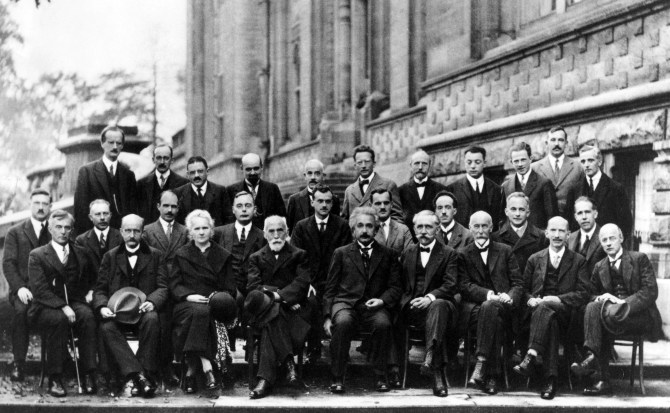
The featured image accompanying these lines is one of the most famous in the history of science. The photograph, taken during the Solvay Conference in 1927, shows Marie Curie surrounded by men, including Niels Bohr, Albert Einstein, and Erwin Schrödinger. "But this iconic image, far from being a thing of the past, remains a sad reality."
It is indicated that there are various data that confirm this evidence. "No woman chairs a public research organization in Spain. Spain remains above the European average in terms of the number of female doctors and researchers, with 391 female PhDs and researchers of the total, a percentage that has remained stable since 2009 and exceeds the EU rate (331 female PhDs and researchers). However, this positive figure is overshadowed by the fact that gender inequality remains evident as one advances in scientific careers and in governing bodies."
It adds that "the discrimination suffered by thousands of women around the world, far from being a historical fact that has gradually changed due to their incorporation into the educational system and the labor market, is still very present. According to the conclusions of a report prepared by the Workers' Commissions, Women must work 109 more days to earn the same as a man«.
On the other hand, "the payroll is not the only barrier to that glass ceiling. Also the lack of visibility Female discrimination is a problem that causes serious prejudices about women's abilities to access positions of responsibility or receive awards for their work. As an example, it is enough to remember that the last edition of the Nobel Prize winners recognized the work of seven scientists, two economists, one politician, and one musician. None of them were women.
The note states that, "unfortunately, sexism in science, as in other areas of our lives, is a reality. Since 1901, Only 31 women have been awarded a prize by the Swedish Academy.The Nobel Prizes aren't the only awards that forget about the 50% of the population. This also happens with awards like the Jaume I Prize from the Valencian Government or the BBVA Foundation's Frontiers of Knowledge Prize.
Finally, it is emphasized that the lack of visibility and recognition is not "a historical problem that will be solved." "The barriers that cause gender inequality, many of them still invisible, do not disappear on their own. Scientific evidence has revealed the existence of cognitive biases that discriminate against women in favor of men. In this regard, a famous study published in the journal PNAS announced the John-Jennifer effect. Researchers and academics, of both genders, preferred men over women even if they had the same curriculum vitae and qualifications.


 English
  Spanish