
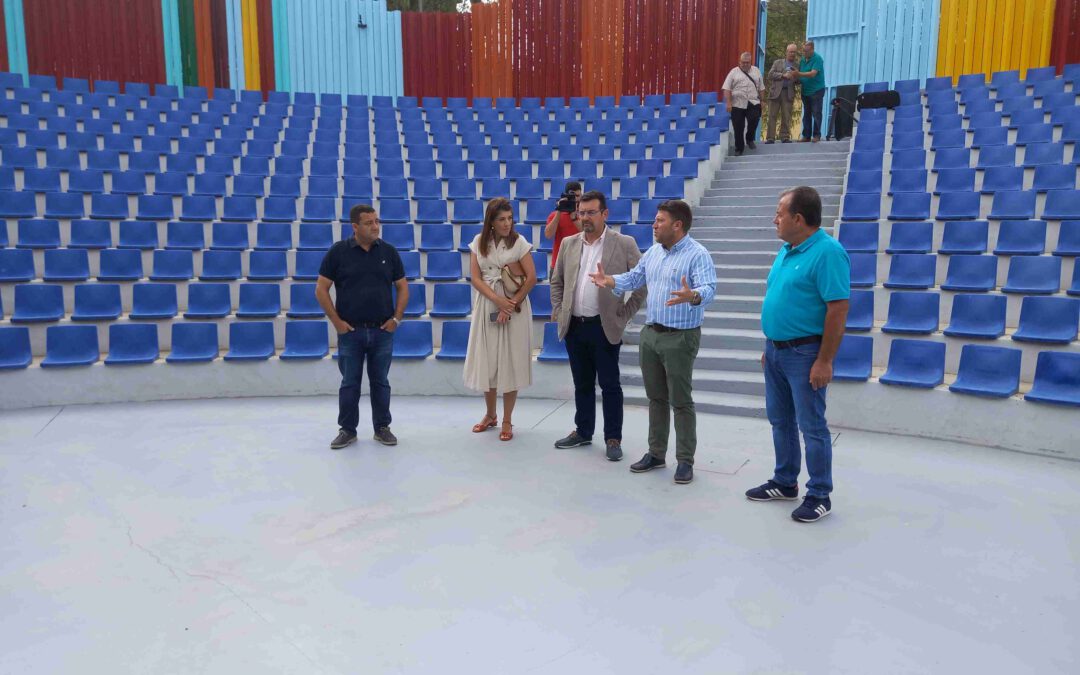
Accompanied by the mayor of the municipality, Tomás Rubio, and the manager of the ADRI Vega del Segura group, José Luis Tornero, he visited the remodeled Gabriel Celaya Municipal Auditorium and the reconditioned former landfill this Thursday.
The Director General of the Common Agricultural Policy, Juan Pedro Vera, has inspected the Gabriel Celaya Auditorium, which has undergone a renovation and accessibility project subsidized with €100,000 co-financed by the Autonomous Community and European LEADER funds, and promoted by the Vega del Segura Local Action Group.
Specifically, the accessibility work carried out consisted of demolishing part of the stands to expand the seating for people with reduced mobility, replacing the flooring and installing a parapet wall, as well as demolishing part of the access ramp to the dressing rooms and redesigning them in accordance with accessibility regulations, including a landing and installing handrails. Non-slip flooring has also been installed.
Refurbishment of the Gabriel Celaya Auditorium
The auditorium's operational work included opening a space in the stage and installing enclosing carpentry, structural shoring, demolition of the projection booth and installation of flooring and parapets, and installation of an installation box. In addition, a trench was dug in the stairwell and stalls with manholes in the stalls to provide conduits for the lighting and sound consoles, a movable enclosure, cleaning of drainage manholes, and installation of a non-return valve.
Finally, self-leveling terrazzo flooring was installed on the stage and central courtyard, as well as phenolic wood cladding on the stage façade. The dressing room area was redesigned with adapted restrooms, new electrical and plumbing installations were added, and a false ceiling was installed.
After visiting the auditorium, they moved to the former Cieza landfill. The Department of the Environment carried out an environmental restoration project on the land occupied by the former municipal landfill. This involved moving and spreading 30,000 m2 of topsoil and installing an irrigation system to allow the restoration of native species of the Mediterranean ecosystem.
Environmental restoration of the old Cieza landfill
This marked the beginning of the final phase of the most significant environmental restoration project undertaken in the municipality. It began in 2006 when, within the Department of the Environment's Environmental Education Program, a series of initiatives were implemented with municipal schools. These initiatives involved replanting and replacing the vegetation cover installed during the sealing operations at the former landfill. This long-term environmental initiative has now been successfully completed.
During these planting operations in subsequent years, it was found that a large part of the sealed area lacked the quality or minimum thickness of topsoil to allow for this to be carried out. Therefore, in view of the problem this was causing, the decision was made to halt the work and prioritize the search for ways to fill the sealed area with topsoil, as otherwise the repopulation and environmental restoration work would have been futile in the short term.
Work to obtain an adequate thickness for reforestation
Given the magnitude of the actions required, due to the large area of land and the high cost of recovery, a long-term but effective solution was proposed that fit with what is now called the circular economy. It consisted of proposing that in all municipal works where the extraction of topsoil was planned, the obligation to provide it on said land would be included in the projects, which reduced costs, avoided landfill disposal (prohibited for topsoil) and meant significant economic savings in taxes, transport and natural resources, in addition to achieving the necessary contribution of topsoil at zero cost to continue with the reforestation works.
Once the necessary topsoil had been supplied to a sufficiently large area, all that remained was to install an irrigation system and spread the piles of topsoil so that the layer remained approximately half a meter high.
Contribution of LEADER funds
The remaining step was to find funding, which was secured thanks to the contribution of LEADER funds. The project cost €26,740.88, of which €18,976.43 was contributed by LEADER funds. This allowed the Department of the Environment to begin implementing the project to move and spread the topsoil and install the irrigation system.
Following the project's completion, the City Council will resume planting native species of the Mediterranean ecosystem, thus consolidating the environmental restoration of this once severely degraded area.
Mayor Tomás Rubio praised both projects, particularly highlighting "the involvement of the educational sector in the refurbishment of the former municipal landfill, an initiative included in the environmental education program that will help Ciezan schoolchildren become aware of the importance of sustainability in our world."


 English
  Spanish