
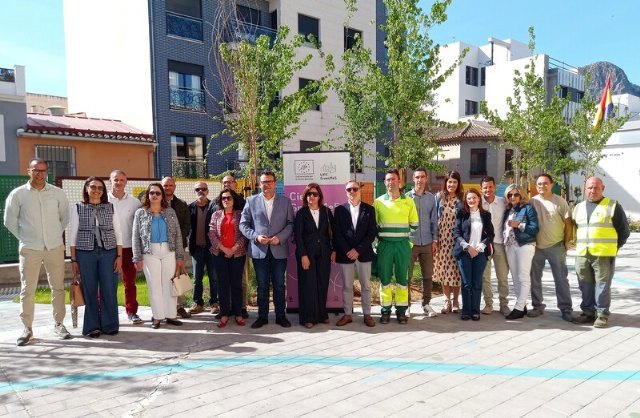
This week saw the inauguration of the renaturalization and implementation of nature-based solutions at the Cristo del Consuelo School, an action developed within the framework of the LIFE-GREENME5 project.
This event highlighted the transformation of the school into a greener, healthier, and more sustainable space, focused on the well-being of students and the entire educational community. The LIFE-GREENME5 Project is co-financed by the European Union.
The mayor of Cieza, Tomás Rubio, stated that "the LIFE reenMe5 project continues to advance steadily in Cieza, consolidating itself as a key initiative within the Green City Accord, a European commitment to improve urban sustainability and environmental quality in participating municipalities," adding that the intention is to develop the experience in other educational centers in the city.
This program, a collaboration between five European cities—Helsingborg (Sweden), Murcia (Spain), Cieza (Spain), Arezzo (Italy), and Vilnius (Lithuania)—focuses on the five fundamental pillars of the Green City Accord: air quality, water quality, noise, waste management, and biodiversity. In Cieza, the project has centered on the renaturalization of the Cristo del Consuelo Primary School, a pioneering initiative in the municipality that aims to transform school spaces into greener, healthier, and more sustainable environments. This intervention represents the first urban school renaturalization project in Cieza, with the goal of improving biodiversity and promoting a diversity of ecosystems in a familiar and everyday setting for young people.
The renaturalization of school playgrounds is a firm commitment to improving children's well-being and adapting educational spaces to climate change. Traditional playgrounds, dominated by concrete and lacking shade, do not meet the current needs for students' physical, cognitive, and emotional development. Incorporating nature and a diversity of uses allows for the creation of healthier, more comfortable, and educational environments that foster creativity, social interaction, and a connection with the natural world. In addition to improving thermal comfort and air quality, these spaces become valuable educational resources by integrating natural elements—vegetation, water, soil, and wood—that stimulate curiosity, cooperation, and respect for the environment. The transformation of the playground at CEIP Santo Cristo del Consuelo is part of Cieza's Strategic Plan for Urban Ecology and Biodiversity, aligned with the Sustainable Development Goals and a nature-based solutions approach.


 English
  Spanish