
Professor Ignacio Martín Lerma of the University of Murcia and Didac Román of the Jaume I University have already seen evidence of the existence of cave bears, something unique so far south in Europe.
When University of Murcia professor Ignacio Martín Lerma managed to insert his head after months of excavation and shine a flashlight inside to examine what lay behind the rocks inside the Cueva del Arco cave in the town of Cieza, he found that his and his team's suspicions—that behind it lay a cavity of indeterminate length, which, in any case, would not exceed twenty meters—were correct: right in front of him lay the expected cavity. But what they believed would be a few meters long multiplied that figure by hundreds. So many times that, today, and barely explored in its entirety, it has already become, at over 1,500 meters, one of the five longest cavities in the Region of Murcia. Professor Martín Lerma stated during the presentation of the discovery that this newly discovered cavity "opens a new door to prehistory."
The discovery was absolutely spectacular, but that wasn't the most impressive aspect of that cavity, which would still hold—and will probably continue to hold—numerous important surprises, so many that even today it continues to be a place that will undoubtedly provide, according to the UMU professor, extremely important discoveries.
The beginnings
But let's go back to the beginning to answer the unknowns - some of them, because this unique place will continue to raise numerous questions about this cave that will have to be answered little by little: its first campaign started in 2015, and from the beginning it has aroused great scientific interest and had an enormous social impact, with constant appearances in the media for constituting a unique and invaluable space for the study of our prehistory, which earned it the epithet "The Cathedral of the Paleolithic" by Manuel Pimentel for the monumentality of its archaeological finds.
Different prehistoric occupations
The Cueva del Arco is a group of caves concentrated in a large natural rock arch in the Almadenes Canyon, located in the town of Cieza. Since 2015, the existence of occupations belonging to the Early Neolithic (7,000 years), Solutrean (21,000 years), Gravettian (30,000) and Mousterian (50,000) periods has been confirmed, constituting one of the few sites in the peninsular Mediterranean where the transition between Neanderthals and modern humans can be documented.
The excavation work was directed by Ignacio Martín Lerma of the University of Murcia and Didac Román of the Jaume I University of Castellón, along with a group of speleologists from the Geca Group of Cieza.
You suspect a larger cave
It was during the 2018 campaign that the group began to suspect they were facing a cavity filled with sediment that could conceal the passage to a larger cave. Various discoveries, which Professor Martín Lerma meticulously describes, suggested this was the case. The work was heavy and slow, but everything was done quickly in the hope of finding something more significant. Finally, the removal of some blocks revealed a clear hole through which air could be perceived. The signs that they might find something much larger grew, but all work had to be carried out with caution. The most important thing was to ensure the safety of any potential discovery. Therefore, the entire perimeter of the Arco Cave had to be sealed off to secure the works, the contents, and the container of this unusual place, the extent of which was still unknown, and to preserve the entire surface as intact as possible.
An unexpected circumstance that surprised the world at the time: the Covid pandemic, something that would significantly delay some of the actions that were about to take place.
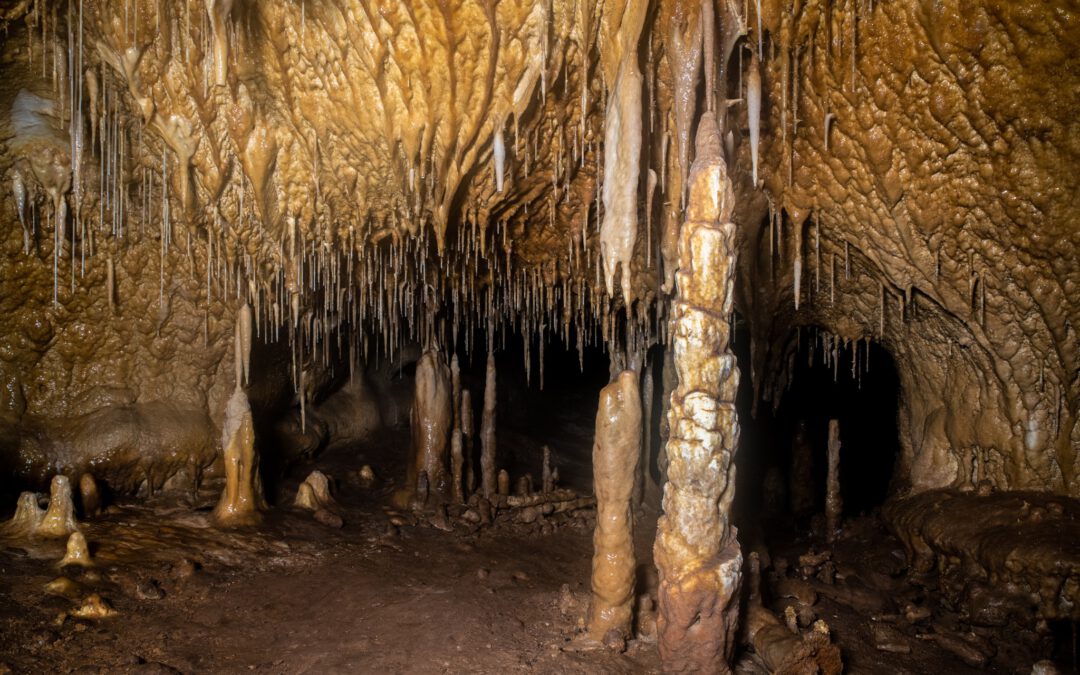
Given the importance of everything that was being discovered, the team decided to contact Dr. J.M. Calaforra of the University of Almería, one of the world's leading experts on the underground world. The goal was to have him join the project and give his authoritative opinion. His opinion was immediate: we were witnessing a world-class discovery. Its enormous size, while one of the most significant aspects, was not the most surprising: the enormous height of its chambers, some up to 20 meters high, makes it the cave with the highest vaults in the region. Its stalactite chambers are unparalleled in the world, with specimens reaching three meters in length and one centimeter in diameter, which have originated and grown in conditions of virtually unrivaled stability, thanks to the isolation of the cavity for many millennia.
To all this must be added what this space can offer on an archaeological level, the scope of which remains unknown, but with enormous potential, given that claw marks from bears measuring more than three meters have been documented, a species believed to have never descended from the area where Madrid is located today.
Keep the place safe from visitors
For Professor Martín Lerma, there is no doubt: "This is a cavity of great geological and archaeological interest, both for its formations and for the perfect preservation of everything it contains, which has been maintained thanks to the strict protocol we followed during its exploration." Therefore, visits must be prohibited until all scientific studies are completed: "We must bear in mind that we have an intact natural treasure in our hands, and that is how it should remain."
"Due to the geological characteristics of the cave, we had suspected for some time that something like this could happen, but it exceeded all our expectations," says Ignacio Martín Lerma, the project's scientific director.
The formation of the enclave must have been related to deep flows, possibly thermal, but with no direct connection to the outside world, making it a unique example of the geological evolution of the area's aquifers. The "unique cavity," as described by José María Calaforra, Professor of External Geodynamics at the University of Almería, is a "virgin space," undisturbed by human activity, which provides an "unparalleled opportunity for paleoclimatic research and advancing our understanding of climate change."
The Trail of the Cave Bear
The event was presented today by Marcos Ortuño, Minister of the Presidency, Tourism, Culture, Youth, Sports, and Spokesperson; Sonia Madrid, Vice-Rector for Studies at the University of Murcia; and Pascual Lucas, Mayor of Cieza, along with Ignacio Martín Lerma and Didac Román, professors of Prehistory, co-directors of the excavations at the Cueva del Arco; José María Calaforra, Professor of Geology at the University of Almería; and Pedro Ríos, representative of the GECA Speleological Group of Cieza.
The mayor of Cieza, Pascual Lucas, highlighted "the potential of the discovery to enhance the natural, historical, and heritage treasure of the Almadenes Canyon and the Region of Murcia as a whole. Cieza is Neanderthal territory, and its study will benefit not only regional archaeology but also humanity as a whole." The Minister for the Presidency, Tourism, Culture, and Sports, Marcos Ortuño, closed the event by emphasizing the "discovery" that "once again places the Region of Murcia on the most up-to-date map of Prehistory."
At the official presentation at the Regional Film Library, the co-directors of the excavations, Ignacio Martín Lerma and Didac Román, both PhDs in Prehistory, emphasized the incredible treasure found and the great potential of the cave: "The identification of cave bear claw marks on many of the walls positions the cave as a great example of a home for these large mammals in southern Europe, something truly unique."
Source: University of Murcia.


 English
  Spanish