
Promoting and raising awareness of the wide variety of stone fruit and melons from the Region of Murcia at strategic points visited by tourists is the objective of the campaign launched by the Association of Fruit and Vegetable Producer Organizations (Asopex), as part of the projects developed by the Campoder Local Action Group, co-financed with €24,000 from European EAFRD funds and the Autonomous Community.
Specifically, two events were organized to distribute stone fruit, grapes, and melons to international tourists at the port of Cartagena, the arrival point for numerous cruise ships; another at the Region of Murcia International Airport; and a fourth at the Archena Spa.
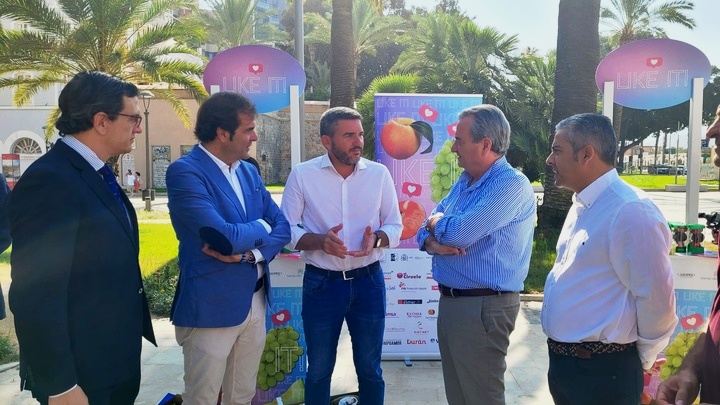
At the campaign launch, held today at the Port of Cartagena, the Acting Minister of Water, Agriculture, Livestock, and Fisheries, Antonio Luengo, explained that "we aim to enhance the quality of these products and improve their marketing, making them known to a diverse audience from very different backgrounds."
Around 3,000 containers will be distributed at the port of Cartagena over the two planned days, and 500 will be distributed at both the regional airport and the Archena Spa.
The campaign in the port of Cartagena will take place on July 13 and 17, and the stone fruit will be delivered in tubes tailored to the size of the fruit. These tubes will be displayed at corporate counters and attended by specially hired personnel. An informational brochure and sustainable bamboo bottles will be provided along with the product. Children will receive corporate balloons. The same procedure will be followed at the events at the regional airport and the Archena Spa, the dates of which have yet to be confirmed.
Luengo emphasized that "the Region of Murcia deserves to be known and recognized as a national and international producer and supplier of top-quality products, such as those offered in this campaign." The acting regional minister also highlighted "the research and innovation capacity we possess, thanks to the work we have been carrying out for many years at the Murcian Institute for Agricultural and Environmental Research and Development (IMIDA), which reports to the regional ministry."
He noted that less than a month ago, new varieties of stone fruit were introduced, such as peaches, Paraguayan peaches, and plums, among others, with high taste quality and better adapted to climate change. In this way, "we meet the demanding requirements of consumers, but also the challenges posed by the environment. Furthermore, the development of new varieties allows for early or late production, allowing for market access under advantageous conditions, that is, during periods of non-production, as is the case with stone fruit, an international benchmark for our region in terms of its production and marketing," he indicated.
Along these lines, IMIDA's Fruit Tree Breeding Department has agronomically evaluated more than 50,000 peach intervarietal crosses since its inception, registering 21 varieties of commercial interest with optimal climate adaptation characteristics and excellent taste. These varieties are currently in production because they meet the qualities demanded by citizens and marketers around the world.


 English
  Spanish