
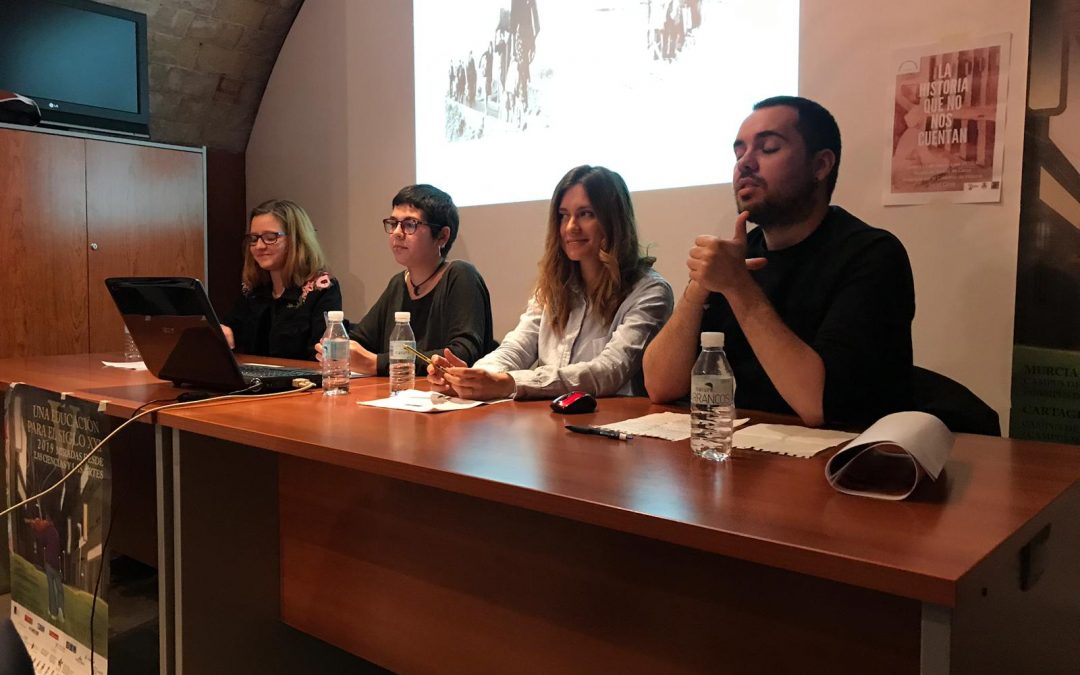
The Cieza Social History Collective returned to the town, this time meeting at the Siyâsa Museum. Their lecture, "The History They Don't Tell Us," which focused on contemporary Spanish history, packed the room, with some people even standing throughout the entire talk.
The presentation to the group was given by Pepe Belló, a writer, who highlighted the research work and the importance of understanding social history for the development of the present. During the conference, attendees heard the "forgotten stories" of slavery in Spain; the fundamental role of women in the Industrial Revolution, particularly the cigar makers; the soldiers lost in the Rif War, including those from Cieza who participated in the conflict; and finally, the financing of the Spanish Civil War. The group provided pamphlets containing chapbooks for all attendees. "We wanted to rescue the popular literature that explains the historical events we narrate. The testimonies and events that were forgotten in textbooks return contextualized on paper." The Cieza Social History Collective also employs innovative dissemination methods, such as audiovisual materials and social media, to reach all audiences.
The group was founded in 2017 with the aim of fostering critical reflection on the subject of history and situating it within society. Ignorance of our past contributes to the growing sense of bewilderment in which we live. The group asserts: “Now, more than ever, against the deliberate erasure and the attempt to control history, we must fight for our memory and rescue the life stories of those who dedicated themselves to the defense of justice, freedom, and equality.” In their presentations, the group brings to light perspectives often overlooked in history textbooks, uncovering, through social research, the stories that “are not being told.” This new lecture series was launched at the University of Murcia with historian Fernando Hernández Sánchez, and they subsequently took their educational project to cities such as Caravaca de la Cruz, Alhama de Murcia, and Molina.
The presentations are part of the "5th Conference on Education for the 21st Century: A Perspective from the Sciences and Arts," a reflection on the educational model organized by the University of Murcia, the Polytechnic University of Cartagena, the El Agua Science Museum, Murcia, and the Francisco Rabal Regional Film Library. Other local contributions include the Cieza City Council, the Forum for Thought and Dialogue, the Atalaya Club, the Los Albares Secondary School, Cieza Ciudad Educadora, the Maestro Gómez Villa Music Conservatory, and the Cajamurcia Foundation.
The next step for the Cieza Social History Collective is to reach out to students in Cieza's secondary schools on April 2nd and 4th. Ultimately, their message is: "The future of humanity depends on the future of the past."


 English
  Spanish