
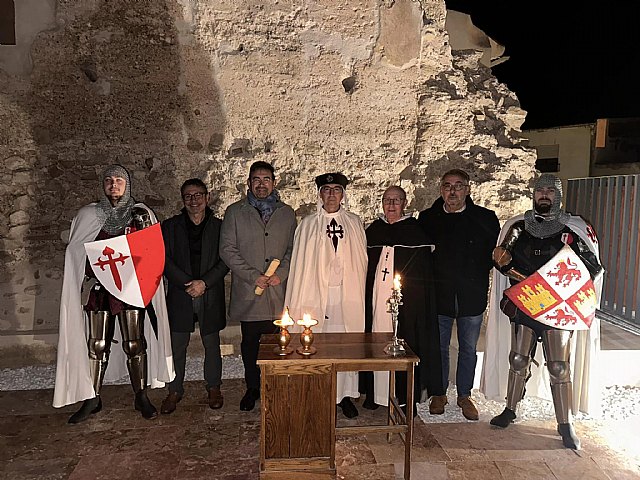
This Saturday, the Balcón del Muro hosted the presentation of the consolidation work on the Christian fortress, which, built starting in 1479 after the Nasrid attack of April 6, 1477, has revealed a tower and part of the defensive wall, among other original elements. The discovery was the result of the renovation work on the Casa de la Encomienda, which began in 2021.
The presentation was attended by the Councilor for Historical Heritage, Amparo Belmonte; the Director of the Historical Heritage Service, Joaquín Salmerón; the architect of Cieza City Hall, Juan Buitrago; and the Mayor of Cieza, Tomás Rubio. The event was also attended by the councilors of the governing team, regional deputies Alberto Garre and Antonio Martínez, and the president of the Brotherhood of San Bartolomé, Cristóbal Herrera.
Salmerón explained that "we thought both the tower and the wall that were found no longer existed, since various written sources attested that the wall's materials had been used for other buildings in the town." In his presentation, he also said that the pavement found confirms what the sources say: that the town was burned, as it contains a thick layer of charcoal, ash, and burnt ceramics."
The House of the Encomienda
Regarding the findings recorded at the Casa de la Encomienda, the director of the excavations reported that "four consecutive arches measuring 2.40 meters and five arches partially covered over the last 526 years were found." During the work on the commander's residence, built within the fortification, all of the original walls of the house were found to have been built of lime adobe.
For his part, the municipal architect spoke about the work carried out at the site, which, in his opinion, "has focused on consolidating the remains of the tower and the defensive wall in order to protect them and prevent their deterioration." He also referred to the fencing that protects the site and the nighttime illumination of the remains.
Both the Councilor for Historical Heritage and the mayor agreed on the importance of the artifacts recovered from the ancient Christian fortress and encouraged the town's residents to "enjoy the rich and varied heritage that the municipality treasures, which has now been enriched by these new discoveries."
Herrera was responsible for introducing the reenactment performed by members of the Brotherhood of San Bartolomé about the visit ordered by the Catholic Monarchs to the town in 1495, once the construction of this quadrangular defensive bastion topped with four corner turrets and a keep was completed. The remains, declared a Site of Cultural Interest, are protected by a fence.
Source: Cieza City Council.


 English
  Spanish